April 27, 2026
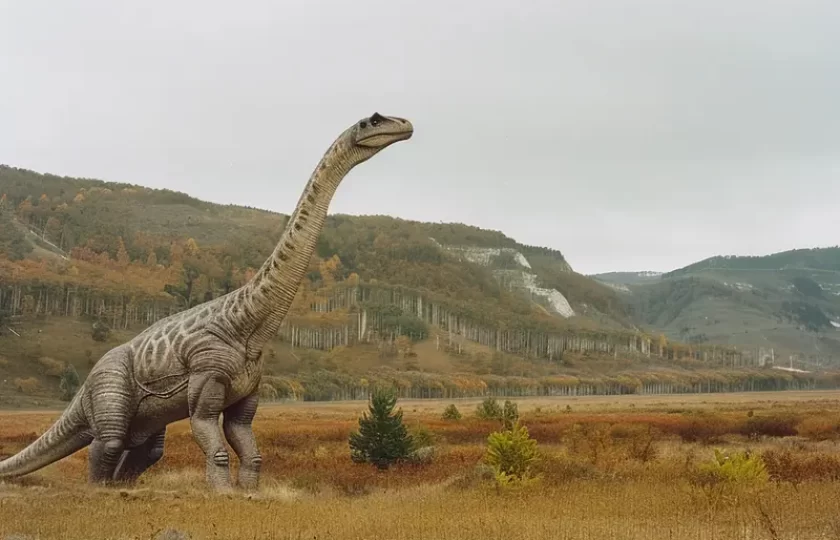
Palaeontologists have discovered a 92-foot-long dinosaur in China from the Late Jurassic period. It is a giant sauropod dinosaur named Tongnanlong zhimingi. The fossil was found in Chongqing’s Tongnan District in rocks that spanned nearly 147 million years ago. The area is known as the Suining Formation, a Late Jurassic sedimentary unit in Sichuan. Scientists say the dinosaur belongs to a family of sauropods that had extremely elongated necks. Tongnanlong zhimingi have three back vertebrae, six tail vertebrae, a shoulder girdle, and hindlimb parts. Estimating the entire length of a dinosaur without having a full skeleton was tricky.
But the shoulder blade gave away the dinosaur’s length, which is estimated to be between 75 and 92 feet. “The new specimen enriches the diversity of Mamenchisauridae and provides additional information for understanding the evolution and diversity of eusauropod dinosaurs,” Xuefang Wei of the Chengdu Center of China Geological Survey wrote in the paper.
Sauropods are a species of dinosaurs that had extremely long necks. Never have all the pieces of a dinosaur belonging to this group been found. This makes estimating the entire length of the dinosaur difficult. Another paper also stated the same thing, that most famous sauropod necks are incomplete, so reconstructing them has been a challenge. The team that discovered the latest dinosaur took a cautious approach and only worked around plausible estimates. The main things at their disposal were long bones like the scapula and fibula. Based on these bones, the team reached various numbers. Their data showed that even by the most conservative standards, the dinosaur found in China was humongous. They have pegged it to be at least 92 feet long.
The Suining Formation has previously revealed fossils of the long-necked dinosaur Qijianglong guokr. A paper on them stated that at the time these dinosaurs diversified during the Late Jurassic period. To find another long-necked dinosaur in the same area shows that several large, long-necked lineages shared the region. The discovery fills gaps in the Sichuan Basin’s Late Jurassic record, showing that mammoth mamenchisaurids lived alongside smaller dinosaurs of the same family.